

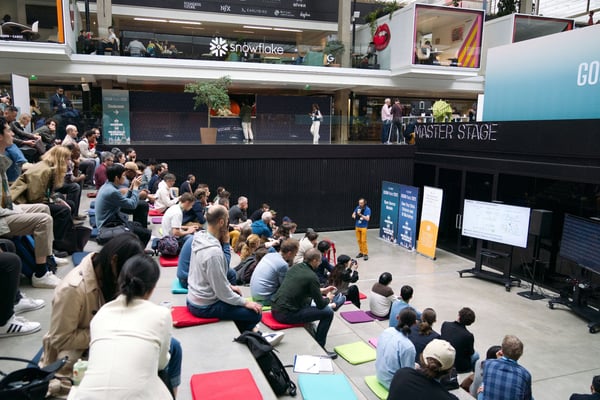
On Tuesday, May 5th, we packed the Open Stage at Station F for a full day dedicated to “Own Your...
This week is London Data Week 2026, a public city-wide festival centered around data in the public interest.
We are proud to have kicked off the week with a hackathon called “AI helped you train your ML model, but can you vouch for it?” with the Data for London team – a team tasked by the Mayor of London to make it easier to share and use data held across London to improve the lives of Londoners.
Participants teamed up to develop machine learning models to tackle three major policy problems faced by the Greater London Authority:
- Can we help London’s young people find work, education, or training?
- How do we decarbonize London’s buildings?
- How can we improve searching for London’s data?
The name of the game wasn’t just to build the best model for the given problems, but to be able to evaluate, explain, and vouch for the model, too. The participants used Probabl skills to get their AI agents to follow best practices when generating their machine learning pipelines, and our open source library skore to easily inspect models and produce evaluation reports.
The reason for this focus: being able to vouch for a model, especially one that is generated by AI, is a non-negotiable skill and condition for trust in both enterprise and policy contexts. Indeed, whether you’re using machine learning to create better services and products for citizens or customers, validation is a crucial step. In practice, it means data science teams can confidently explain models generated in part or full by AI, and MLOps teams can confidently put those models into production and trust the outcomes.

My conversation with Martine Wauben
I sat down with Martine Wauben, the Head of Data for London, on the fringes of the hackathon to learn more about what validating machine learning models means in a government context like the Greater London Authority.
Cailean Osborne: Can you tell us a bit about yourself and the kinds of problems the GLA Data for London team works on day-to-day?
Martine Wauben: The Mayor of London wants to make it simpler for people to share and use data held across London to improve the city and benefit Londoners. The Greater London Authority and LOTI turn data assets into data services that solve real problems for Londoners. We help select good problems to solve, learn from and deploy effective delivery models (people, process, data), and help deliver real value through partnership. The Data for London program is building a new platform and support service for data sharing. We have already released the Data for London Library, which is being developed into a user-friendly service to facilitate easy data discovery.
Cailean Osborne: You’re a veteran data scientist in the public sector, having led data science teams at the GLA, the Department of Health and Social Care, and Number 10, among others. Based on your experience, what do you find are the hardest challenges for generating impact with data science in a government setting?
Martine Wauben: Data scientists build insights on top of a foundation of good data engineering, cybersecurity practices, and data governance. The public sector has historically struggled to “fix the plumbing”: massive legacy systems are expensive to modernize, fields are not always standardised between teams and departments, and it is key to strike a balance between data protection and data sharing for public value. This means data scientists are often limited in the data available to work with, which constrains the types of modelling that can be done. Data for London aims to improve this for London, and there are equivalent national initiatives to enable data use and sharing across the UK.
Cailean Osborne: When a ML model informs a policy decision the stakes of getting it wrong are real for citizens. Based on your expertise, which best practices do you recommend for evaluating and validating models in a policy context?
Martine Wauben: In a policy context, it is even more important to make sure our services work for everyone. Unlike commercial companies who get to decide their “target demographic,” government does not get to pick its customers: every Londoner should be able to access them! This means we have to be especially careful about not only validating a model on training- and test set performance, but also check that our dataset is representative of the population as a whole. In some cases, it may be necessary and useful to over- or under-sample to rectify an unbalanced dataset. If a group is currently excluded, they will not appear in the data at all. This would make a model look more accurate than it actually is, further entrenching the bias.
Cailean Osborne: We designed the hackathon around the importance of being able to vouch for an ML model, especially as AI coding assistants can now generate ML pipelines in seconds. What does it mean to you to be able to “vouch for a model”?
Martine Wauben: The Mayor of London wants to make sure advances in data science and AI work for all Londoners. It is really important to us that the way we use data can be explained and interrogated for potential bias, so we can make informed decisions about how we deliver city services. In the era of generative coding tools, this includes interrogating how the model is built and why certain design choices were made.
Cailean Osborne: What was your personal highlight from the hackathon?
Martine Wauben: London Data Week, for me, is an incredible opportunity to meet Londoners who work with data to deliver valuable projects: big and small, innovative and foundational, and more or less technical. At this hackathon, I got to meet those who are keen to learn more and are willing to apply their skills to help solve real, current problems for the city. It was wonderful to see the creativity and expertise on display, and what can be done when a group of skilled people get together with just a few hours’ spare.
Thanks to Martine and the wider Data for London and London Data Week teams for the fun hackathon!
.jpeg?width=680&height=778&name=WhatsApp%20Image%202026-07-06%20at%2012.05.34%20(1).jpeg)
About Martine Wauben
Martine Wauben is Head of Data for London at the Greater London Authority, realizing the Mayor of London's vision to make it simpler for people to share and use data held across London to improve the city and benefit Londoners. Previously, she was a government data scientist and statistician at Number 10 Downing Street, the Department for Health and Social Care, and the Ministry of Justice. She has worked internationally in Rwanda and Nepal. She also seeks out opportunities for collaboration and sharing of best practice with other cities and governments across Europe and globally.
For more from Probabl
- Follow our latest updates on LinkedIn
- Subscribe to our monthly newsletter
- Watch over 100 technical videos on our YouTube channel