

By Yann Lechelle, Executive President & Chairman of Probabl
The rise of AI coding assistants has sparked much debate that cuts to the heart of what it means to be a data scientist or software engineer today. Are these tools making us more productive, or are they eroding the skills that made those roles valuable in the first place? And as enterprises recalibrate what they expect from technical hires, practitioners are wondering how they should invest in their own development, and how can they credibly signal that they've done so?
These aren't abstract questions. They’re shaping hiring decisions, career trajectories, and the way organizations think about training and credentialing their technical workforce. Yet until recently, most of the answers have come from anecdote, hype, or extrapolation from small studies. That's starting to change.
A new study by a team of researchers from LinkedIn and GitHub is one of the first to examine - at scale - what actually happens inside companies after they adopt AI coding assistants. Rather than relying on surveys or lab experiments, the researchers tracked real hiring and skills data across tens of thousands of enterprises over six years. I sat down with Mar Carpanelli from LinkedIn to unpack what they found and what it means for anyone building their career in data science or software engineering today.
What the data says
Matthew Baird, Mar Carpanelli, Brian Xu, and Kevin Xu from LinkedIn and GitHub recently published their study "Enterprises' GitHub Copilot adoption and labor market outcomes for software engineers" in the journal Contemporary Economic Policy.
Using a combination of LinkedIn and GitHub Copilot licensing data across approximately 26,000 enterprises between 2018 and 2024, they apply doubly robust difference-in-differences methods to compare hiring and skills outcomes at enterprises that adopted GitHub Copilot against observationally similar enterprises that did not.
The following three insights stood out to me.
Key finding 1: The adoption of AI coding assistants tends to increase hiring, not layoffs, of technical talent
Enterprises that adopted the AI coding assistant showed a 3–5% higher monthly probability of hiring software engineers compared to observationally similar non-adopting enterprises. The effect was strongest for non-manager individual contributors (ICs), with a 6.6% higher likelihood of hiring entry-level ICs each month. Far from replacing engineers, the researchers conclude that AI-adopting enterprises are expanding their engineering headcount.
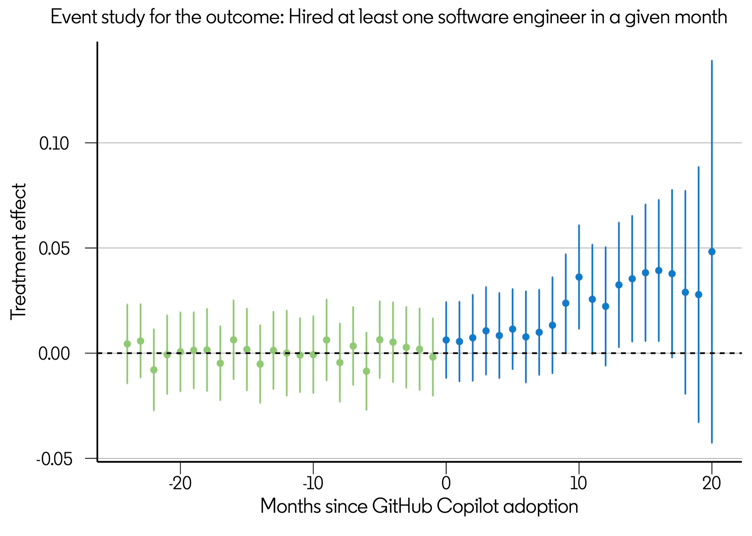
Figure 1: Enterprises that adopted GitHub Copilot AI tended to hire at least one software engineer in a given month
Key finding 2: New engineering hires are expected to bring more to the job than just coding skills
Among new engineering hires at enterprises, non-programming skills like communication, collaboration, project management, and domain expertise increased by approximately 5–13%, with no corresponding decline in coding skills. Enterprises with high adoption rates also saw existing engineers acquiring more non-programming skills over time. The takeaway: the profile of the software engineer that enterprises are hiring is broadening, not narrowing.
Key finding 3: Higher adoption rates correspond with increases in hiring probability and skill diversification
The labor market effects were not uniform – they scaled with how widely the AI coding assistant was adopted within an enterprise. Companies with higher adoption saw larger increases in hiring probability and skill diversification than those with low adoption rates. This dose-response relationship strengthens the case that the findings reflect genuine AI-driven changes in how enterprises organize work, rather than a selection artifact.
Matthew Baird acknowledged in his LinkedIn post about the study that these effects are specific to the early-adoption period of AI tools by software engineers, and he recommended that future research should check whether the trends persist. Matthew added that on-random Copilot adoption means causal claims require caution, but that they used doubly robust difference-in-differences methods designed for staggered, non-random treatment adoption, and their results hold across many robustness checks, including a placebo test using stock price changes that found no evidence Copilot-adopting enterprises were simply on better financial trajectories to begin with.
My conversation with Mar Carpanelli
I sat down with Mar Carpanelli from LinkedIn to learn more about these findings and the key questions researchers of AI and skills are currently working on.
Arturo: Mar, before we get into the weeds of the findings, I'd love it if you could share with me your big picture perspective on the key questions currently on the minds of experts – like you and your colleagues – who are working at the intersection of AI and the future of work. For example, what do we know so far about the effects of AI coding assistants on technical jobs in areas like software engineering and machine learning, and what do we not know yet?
Mar: We are living through one of the fastest and most consequential transformations of knowledge work in recent memory. In a span of just a few years, AI coding assistants have moved from research demos to everyday infrastructure inside engineering organizations, and the labor market is reorganizing around them in real time. Most prior technological shifts of this magnitude (the personal computer, the internet, cloud) played out over a decade or more, which gave researchers, educators, and policymakers time to catch up. This one is faster. In this context, we have a unique opportunity to track labor market effects in real time, and help workers, employers, and policy makers navigate this time of high uncertainty and rapid change.
To your specific question: what we know is mostly encouraging and mostly short-run. Controlled experiments from GitHub, Microsoft, and a few academic teams show meaningful productivity gains for engineers using AI coding assistants, especially on well-scoped tasks. Our recent publication shows that firms adopting Github Copilot, a tool that can automate many tasks software engineers do, have been hiring more engineers, not fewer, and have been broadening the skill profile they look for. The narrative that AI coding assistants are a one-for-one substitute for engineering labor just isn't supported by the data we have so far.
What we don't know is almost everything about the medium and long run. We don't know how the entry-level pipeline holds up if the tasks that used to train junior engineers get automated. We don't know how the wage premium for AI-fluency evolves once these tools are table stakes rather than a competitive edge. And we don't have good evidence yet on adjacent roles (data scientists, ML engineers, analysts, technical PMs) where the workflows are different and the substitution margins may be very different, too. That gap is where I'd love to see the field move next.
Arturo: Awesome. Let’s now turn to your study. The three insights I’ve taken away from it are: One, companies adopting AI coding assistants are hiring more, not less. Two, there are changing expectations of the non-technical skills that engineers should have. And three, there’s a positive relationship between AI adoption rates and skill diversification in enterprises. I’m curious, did you expect these findings or were you surprised?
Mar: Honestly, a bit of both. The hiring result was the most counter-intuitive one. There was, and still is, a lot of public discussion framing AI tools as a substitute for engineers, so finding a 3-5% lift in monthly hiring probability among AI adopters was striking.
That said, it's consistent with a long economic-history pattern: when a complementary technology drops the cost of a task, firms often end up doing more of the surrounding work, not less. David Autor's work on bank tellers and ATMs is the classic example.
What genuinely surprised me was the skills result. I had expected to see coding skills plateau or even tick down as AI handled more of the routine code. Instead, coding skills held, and non-programming skills, such as communication, collaboration, project management, domain expertise, rose by 5-13%. That tells me firms aren't trading technical depth for breadth; they're asking for both.
The dose-response pattern, which is to say bigger effects at firms with higher adoption, was the piece that gave me the most confidence the signal was real and not an artifact.
Arturo: Your study covers the early adoption period of GitHub Copilot, roughly 2018–2024. What's your intuition about whether these hiring and skills trends will hold as AI tools have become the norm rather than the exception since 2024 and more tools have landed on the market? What do you think has changed since 2025?
Mar: I'd be cautious about extrapolating. Our window captures one technology, in the early-adopter period; and early adopters are not a random sample of firms -- they tend to be more technically mature, better resourced, and more willing to absorb the organizational cost of new tooling. The hiring lift we observe partly reflects those underlying characteristics interacting with the tool.
What's changed since 2025 is the tooling itself. We've moved from suggestion-style autocomplete to agentic workflows that can scope a task, write a PR, run tests, and iterate. That changes the substitution margin. When the tool handles end-to-end execution rather than line-level assistance, the demand mix may shift toward more senior engineers who can specify, review, and integrate, and away from the routine work that used to be the training ground for junior engineers.
Overall, I expect the direction of the skill-broadening result to hold, but the hiring result deserves a fresh look with new data. The composition of who gets hired by seniority and by skill profile is probably where the more interesting story is right now.
Arturo: You found that the demand for non-programming skills grew without any decline in coding skills. What does that tell us about what enterprises are expecting an engineer to contribute in an AI-augmented workflow? Does that change how you think about what a technical education should look like for the next generations?
Mar: I read it as evidence that coding and non-coding skills are complements, not substitutes, in an AI-augmented workflow. If AI can produce a plausible first draft of code, the engineer's value shifts toward the things the AI can't reliably do: framing the problem, evaluating whether the output is actually correct, integrating it across systems, communicating trade-offs to stakeholders, and carrying domain context that isn't in any training corpus. None of that displaces coding skill (you need fluency to evaluate AI output critically) but it stacks on top of it.
For technical education, I wouldn’t minimize the importance of learning fundamentals: computer science fundamentals, statistical reasoning, systems thinking. Those are exactly the muscles you need to be a good reviewer and integrator. What I'd add, and what I think is underweighted in most curricula today, is structured practice in the surrounding skills: writing clear technical specs, giving and receiving code review, explaining technical decisions to non-technical audiences, and building real domain expertise in at least one applied area. In other research we are doing with Fabian Stephani and Jedrzej Duszynski, we are finding that the T-shape skill profile may be more valuable than ever.
Arturo: Research by Dr. Fabian Stephany at the University of Oxford shows that certifications are increasingly how jobseekers signal technical skills and enterprises verify them. He also finds that skills in AI, in particular machine learning, result in the highest wage premiums for professionals. Bridging his insights with what you found about which skills are gaining value, in your opinion what should a meaningful software engineering or machine learning certification demonstrate today compared to, let’s say, five years ago?
Mar: Five years ago, a meaningful certification mostly demonstrated proficiency: you know this language, you can use this framework, you've passed this cloud provider's exam. That's still useful as a baseline, but it's no longer sufficient as a differentiator. The marginal cost of producing technically correct code has dropped, and with it, the signal value of “I can write the code”.
What I think a meaningful certification should demonstrate today is judgment under uncertainty. For software engineering: can you decompose an ambiguous problem, evaluate AI-generated code against requirements you defined, recognize when the easy answer is the wrong answer, and communicate the trade-offs? For machine learning: can you assess whether a model is actually solving the problem you posed, diagnose drift and failure modes, reason causally about what the data does and doesn't tell you, and handle the ethical and governance questions that come with deploying a model?
Fabian's finding that ML skills carry the highest wage premium fits with this. The premium is going to the people who can connect a model's behavior to a business or scientific question and defend that connection. A certification that demonstrates that, can be a powerful signal to employers.
Arturo: You researched the effects on software engineers specifically, but I’d like to expand the scope to data scientists and machine learning engineers, who are the bedrock of our community. I’ve seen that practitioners in our community are increasingly using AI tools to generate code for model building and evaluation without necessarily having deep software engineering backgrounds. Do your findings give you any signal about how AI coding assistants are reshaping skill demands in data science and AI roles, or is that a gap in the research you'd want to see filled?
Mar: It's a real gap, and one I'd love to see the field (ideally my team) fill. Our study deliberately scoped to software engineers because the GitHub Copilot signal is cleanest there, but data science and ML engineering workflows are different enough that I'd be careful about generalizing our results.
That said, I have some intuitions. A lot of the work data scientists and ML engineers do, like exploratory analysis, dashboarding, now has AI-assisted starting points, and that's lowering the technical barrier to producing code that runs.
The risk is that getting something to run gets confused with getting it to run and be right. The opportunity is that the premium on the skills AI can't easily replicate goes up. If anything, I'd expect the skill-broadening effect we see for software engineers to be even more pronounced for data scientists and ML engineers, because the role has always been less about code production and more about connecting data or models with business decisions. But that's a hypothesis, not a finding.
Arturo: What would you say is the number one takeaway for enterprises that have not yet adopted AI coding assistants. Should they be encouraged by your findings?
Mar: The most important takeaway is that AI exposure and AI adoption do not necessarily mean a workforce reduction. The evidence in our study is that adoption is associated with more hiring of software engineers and a broader skill profile, not fewer engineers doing narrower work. So if a firm is hesitating because they are worried about the optics of adopting AI tools and then having to hire, the data suggests those aren't in tension.
The harder question, and the one I'd encourage non-adopters to focus on, is organizational. The tool itself is the easy part. The lift comes from rethinking workflows: how code review changes when first drafts come from an AI, how onboarding changes when juniors have a much more capable starting point, how you measure productivity in a way that captures quality and not just throughput. Firms that adopt without doing that organizational work tend to leave most of the value on the table. So, be encouraged by the evidence, but plan for the change-management work, not just the license purchase.
Arturo: Last but not least, if you could give a word of advice to the data scientists and machine learning engineers in our community about the skills that are worth learning to remain competitive in tomorrow’s job market, what would it be?
Mar: Based on my intuition and our research on in-demand skills at LinkedIn, I’d say three things.
First, double down on statistical and causal reasoning. AI can run any regression you ask it to; it can't reliably tell you which one to run, what the identifying assumptions are, or whether the answer is causal or correlational. That judgment is what makes you trustworthy.
Second, develop real domain expertise in at least one applied area: labor markets, healthcare, finance, recommendation systems, whatever matters to you. Context is the moat. AI doesn't know your business, your data quirks, or the institutional history of why a metric is defined the way it is. You do.
Third, and this is the one I'd emphasize the most, keep the habit of validating output. Don't outsource judgment. Every result AI gives you is a hypothesis until you've checked it. The data scientists and ML engineers who thrive in the next few years won't be the ones who produce the most code the fastest; they'll be the ones who consistently catch the things that AI got wrong.
Learn more about Mar's research on AI and skills
For a deeper dive into Mar’s research on AI and skills, you may enjoy the following resources:
📺 Watch
- The Work Shift. “LinkedIn Guide to Future-Proofing Your Career: What to know about evolving jobs, in-demand skills and strategic moves in the age of AI.” 2025. https://www.linkedin.com/pulse/linkedin-guide-future-proofing-your-career-what-know-evolving-giyqc/
📚 Read
- Matthew Baird, Mar Carpanelli, Brian Xu, and Kevin Xu. 2026. "Enterprises' GitHub Copilot adoption and labor market outcomes for software engineers." Contemporary Economic Policy.
- Karin Kimbrough, Mar Carpanelli. 2023. “Preparing the Workforce for Generative AI: Insights and Implications.” LinkedIn Economic Graph. https://economicgraph.linkedin.com/content/dam/me/economicgraph/en-us/PDF/preparing-the-workforce-for-generative-ai.pdf
- Caroline Liongosari, Danielle Kavanagh-Smith, Kantenga, Mar Carpanelli. 2025. “US Software Engineer Talent Landscape.” LinkedIn Economic Graph. https://economicgraph.linkedin.com/content/dam/me/economicgraph/en-us/PDF/us-software-engineer-talent-landscape-2026.pdf
- Caroline Liongosari, Danielle Kavanagh-Smith, Kantenga, Mar Carpanelli. 2025. “The Base of the Pyramid: Entry-Level Employment Across U.S. Firms.” LinkedIn Economic Graph. https://economicgraph.linkedin.com/content/dam/me/economicgraph/en-us/PDF/Entry-Level-Employment-Across-US-Firms.pdf
About Mar Carpanelli
Mar Carpanelli leads AI and Skills Research at LinkedIn’s Economic Graph Research Institute, and she is a part-time Social Data Science DPhil student at Oxford University. Prior to LinkedIn, she served as an Economist at the Inter-American Development Bank, at the Harvard Growth Lab, and at the G20 & UNASUR via Argentina’s Ministry of Economy. She holds an MPA/ID from Harvard Kennedy School, and a MSc/BSc in Economics from Torcuato Di Tella.
Learn more about Skolar
The scikit-learn core team created the “Machine learning in Python with scikit-learn” MOOC, following the open source philosophy to empower everyone, everywhere. Since 2025, this mission is actively supported by Probabl. We curate the Skolar MOOC, which covers best practices for machine learning Python and the newest functionalities in scikit-learn. Most importantly, it provides learners with guidance to get hands-on experience in a world where code generated by agents has to be validated by capable humans in the loop. Learn more about the MOOC and Skolar certifications on our website.
For more from Probabl
- Follow our latest updates on LinkedIn
- Subscribe to our monthly newsletter
- Watch over 100 technical videos on our YouTube channel