
By François Méro, CEO of Probabl
Data science is being rewritten by AI agents
Tabular data is the foundation of enterprise operations and decision-making. It's the information every business creates and records as it operates: transactions, customers, products, inventory, assets, risks, and more. It’s the information that lives in spreadsheets, CRMs, and ERPs.
Data science is the art and the science of making predictions and decisions based on that data. Its impact is visible in every industry. Predictive models are used for credit decisions, fraud detection, predictive maintenance, customer churn, pricing, you name it.
For as long as enterprises need to count, compare, and decide, tabular data will remain the ground truth on which every predictive model is built.
However, AI is rewriting data science faster than the discipline can absorb it. Agents now generate pipelines in seconds and build models in minutes, work that used to take teams days or even weeks. With the heavylifting delegated to agents, the bottleneck has shifted to validating that agents are enforcing methodological best practices and statistical thinking you'd expect from a seasoned data scientist, not just running code that works.
AI may accelerate data science workflows, but it can't replace human judgment. For the enterprise, that difference determines what you can explain, forecast, control, and protect. In our age of agentic AI, the question is no longer whether AI will change how enterprises make predictions. It is how to combine the speed of AI with confidence in the results.
Speed alone doesn’t make a prediction worth acting on
AI agents write code much faster than humans, but what made predictive models dependable was never just the code. It was the human judgment around it: what to test the model against, how to preprocess messy or incomplete data, which metric really answers your question, how much doubt is acceptable.
In data science, the human in the loop is a feature, not a bug.
Done wrong, AI costs more than it returns: silent errors, security risks, opaque costs, and results nobody can audit. You risk betting on models nobody can explain or vouch for. Token consumption becomes hard to predict. Your teams' hard-won know-how leaks into prompts, agent logs, and plain-text instructions you no longer control. And you can end up locked into tools with no way out.
The market numbers back this up. According to Gartner, 60% of enterprise AI initiatives will miss their expected outcomes through 2027, and only 39% of technology leaders believe their AI investment will materially improve financial performance [1].
This is where Skore comes in
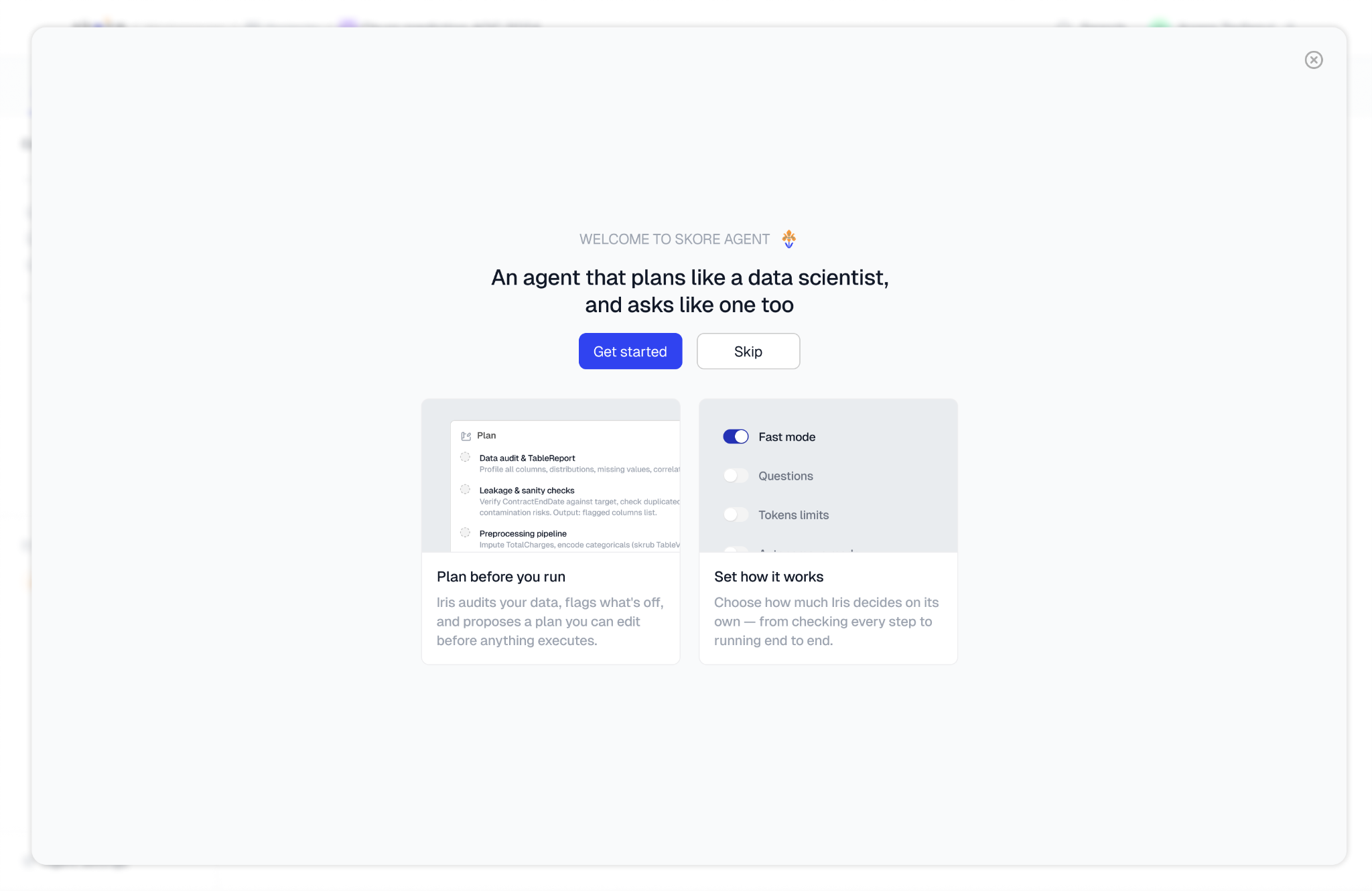
Speed and confidence in the results were never opposites. They only become opposites when judgment is left outside the loop. So we built Skore to keep it in, by design.
Skore is the Tabular AI platform that helps enterprise teams use AI agents to make reliable predictions and better decisions from their tabular data, not just faster ones.
Its agent builds, validates, and tracks models and applies the statistical methodology of the scikit-learn maintainers at every step. Validation, governance, and reproducibility are built in rather than bolted on afterward.
You get AI's speed, with confidence in every model. Internal benchmark results show that Skore reaches a working, deployable model 1.78× faster than general-purpose AI coding agents like DeepSeek V4 Flash.
What Skore does
Skore is designed to keep the human in the loop. Its agents do the heavy lifting, while you keep control of every decision, every model, and every record.
Choose how your agent helps you
In Assist mode, you drive the workflow while Skore suggests next steps, flags methodological pitfalls, and takes on repetitive work. In Delegate mode, you tell Skore what you need and choose how often it checks in with you. Its agent then builds and validates the model for you, with evidence of every step it took.
Catch silent errors
Even when a model looks flawless, Skore flags the silent errors, such as data leakage or the wrong measure of success, including in code written by AI. The failure that would have reached production never gets there.
Compare experiments, stay on track
Every run is tracked automatically, so you can compare models, settings, and results side by side and see exactly what changed from one run to the next.
Select the metrics that match the question you're asking
Skore chooses evaluation metrics that fit your problem and data, and reports uncertainty alongside every score, so you know how much confidence each result deserves.
Agents work inside boundaries you set
Agents reach only the data, tools, and compute you grant them. Credentials are scoped to each workspace, so nothing runs outside the limits you define.
Works with the tools your teams already use
Skore is composable by design: any AI provider, any ML framework, any compute, on cloud, on-premise, or local. It fits between the tools you already have rather than replacing them, so there's nothing to migrate.
Your know-how stays private
Your teams' expertise is captured as private skills that stay inside your company, never in prompts or agent logs.
Every run leaves a record your auditors can follow
Skore documents the inputs, decisions, and outputs at every step, giving reviewers and auditors a complete, traceable history.
What Skore means for your enterprise
Skore adds up to four things for your enterprise.
Better data scientists, not just faster ones
Your teams' judgment is your competitive edge. Skore automates routine work and preserves judgment. Skore catches data leakage and silent methodological errors as it builds models, enabling data scientists to ship reliable models faster.
Lower total cost, faster time to value
Zero adoption costs and nothing to migrate. Licence, tokens, and time are all combined in one equation. Use the right-sized models, only consume the tokens the task needs, and ensure errors never reach production.
Confidence to deploy, operate, and grow
Skore gives you governed access to AI agents and an audit trail that is generated by design rather than assembled as an afterthought. Skore is composable with any AI provider, any ML framework, any compute – cloud, on-premise or local.
AI transformation of data science that you own
Your teams’ judgment compounds into private skills that stay yours, so data science remains a competitive asset – and your tools adapt to your strategy, not the other way round.
Built by the company behind scikit-learn
We come from scikit-learn. We've seen millions of models built,and we steward the open source library the discipline is built on. Now we've built Skore so the next millions can be even better.
Skore is built for enterprises that want to own the AI transformation of their data science practice. In this future, agents will do more of the work, and the enterprise will answer for it. Skore makes sure that answer defensible.
For as long as enterprises need to count, compare, and decide, they'll need models they can stand behind. Skore makes sure they can build them faster.
If you lead an enterprise and want your AI investments in data science to pay off, let's talk: https://www.probabl.ai/contact/
References
[1] Gartner, Forecast Analysis: AI Spending, 4Q25; Gartner, Shift Toward AI-First for Data & Analytics 2030 (March 2026).